MQA-001 · Market Quote Assurance · Method demonstration
The $42 Morgan-Dollar Quote: How Missing Context Changes an AI Decision
A dollar figure can be accurate and still answer the wrong question. Before judging a coin quote, establish who pays whom, for which coin, at what time, and under what conditions.
Prepared November 17, 2026 · AI-assisted, operator-reviewed research · Reconstructed method demonstration
The evidence boundary comes first
Reconstructed method demonstration: the original ZIP and transcript remain unrecovered. No real customer outcome or external AI-model failure was verified.
The assignment describes an anonymous conversation mentioning a $42 dealer buyback offer for Morgan dollars. We have not independently verified the dealer, the coins, the date, the terms or an executable offer. The original conversation and the named pilot ZIP were not recovered. This article reconstructs the decision problem from that description; it does not establish that a commercial AI product failed.
Current case decision: HOLD. There is insufficient evidence to recommend accepting or rejecting that offer.
What did “$42” mean?
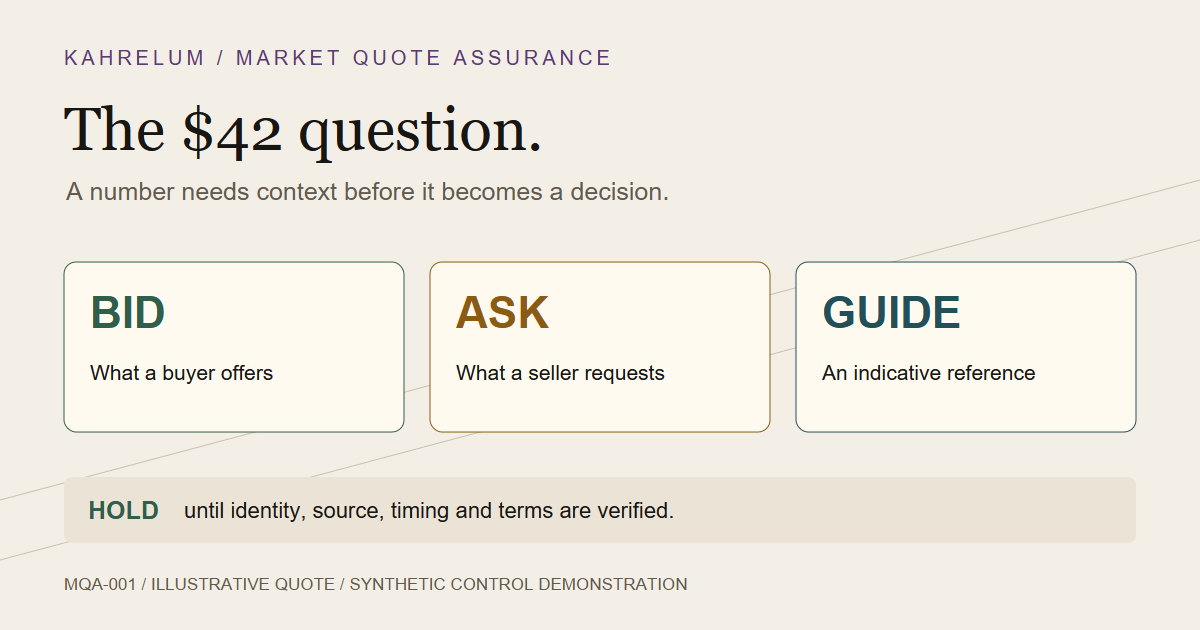
If a dealer offers to buy your coin, $42 is a bid: money you might receive. If the dealer sells you a coin for $42, it is an ask: money you would pay. A price-guide entry is a third object, an estimate that may help frame a comparison. Swapping these categories reverses the decision.
Bid
A buyer's offer, subject to specified coin identity, quantity, inspection, expiry and payment terms. A reported bid is not automatically executable.
Ask
A seller's requested price. An advertised listing is not proof of a completed sale or of what that seller would pay to buy the coin back.
Guide
An indicative valuation. PCGS explains that its guide reports average dealer asking prices for PCGS-graded coins. It does not promise a dealer buyback transaction.
Realizable proceeds
The accepted sale amount less applicable fees, shipping, insurance and other agreed costs. Taxes and other case-specific obligations require separate treatment; they are not silently assumed to be zero.
Identify the object before comparing prices
The U.S. Mint's historical account confirms Morgan dollar production in 1878–1904 and 1921 and the historical standard of 26.73 grams, 90% silver and 10% copper. Modern Morgan issues must not be assigned that historical composition merely because the design has the same name.
Date, mintmark, variety, condition and authenticity can change the appropriate comparison. “Morgan dollar” alone does not identify a collectible. Cleaning, damage and wear matter. A claimed grade is not a verified grade, and a weight calculation cannot authenticate a coin. Obtain a competent examination and the relevant certification record where required.
The calculation, with its assumptions visible
NGC's silver-content table lists 0.7734 troy ounces for the historical Morgan dollar. That is the declared conventional content used in this demonstration. Applying 90% directly to the rounded 26.73 g specification and dividing by 31.1034768 g per troy ounce gives approximately 0.77345051 oz. These rounded conventions are not identical; neither measures the remaining silver in a particular worn or damaged specimen.
For a silver price S in US dollars per troy ounce, the conventional gross metal value is 0.7734 × S. It is a theoretical metal-content value, not guaranteed refinery proceeds or a dealer bid.
Worked example — synthetic, not a market quote
Assume silver is $40 per troy ounce. Metal value is 0.7734 × $40 = $30.936, or $30.94 rounded to cents. Against the illustrative $42 quote, the gross difference is $11.064, approximately 35.76% of that metal value. If a confirmed sale had $2 fees and $1 shipping, net proceeds would be $39. None of those assumptions verifies the anonymous offer.
The difference above melt is an arithmetic premium, not proof of a separately realizable collectible premium. If a total collectible valuation already includes metal content, adding melt again double-counts value. Comparing total bid with total ask or guide also requires matching coin identity, grade, time, currency and transaction costs.
No current spot quote is used to backfill the unknown conversation date. A later price change would be an outcome observation, not evidence that was available for the original decision.
The interpretation error and the correction
Reconstructed incorrect interpretation: treating the $42 figure as a retail purchase price, or treating a higher retail guide entry as proof that selling for $42 is necessarily a bad transaction. This is a demonstration of the category error described by the assignment, not a quotation from a recovered transcript.
Documented correction in this candidate: label $42 as a reported, unverified dealer bid; identify the seller's decision; distinguish a guide from an executable alternative; then return HOLD until the coin and offer can be verified. The original exact wording, speaker, model identity, timestamp and sequence of correction remain unresolved.
We also retain a correction from our own implementation: the first arithmetic test contained an incorrect expected mass conversion. The first implementation run passed 39 of 40 tests. Correcting that expectation to 0.7734505102 produced 40 passing tests. The failed run is retained with the record.
A transparent decision-control demonstration
The reconstructed quote_gate.mjs accepts explicit intent, coin details, quote type, units, costs, observation and expiry times, source references, conflicts and prior decision history. It emits reason codes and an input hash. It performs no network verification and cannot certify a coin or validate a caller's evidence flags.
| Input condition | Result | Required next evidence |
|---|---|---|
| Anonymous $42 conversation | HOLD | Attributable offer, date, terms and coin record |
| Retail guide substituted for a sale bid | HOLD | A verified buyer's offer |
| Expired quote, future evidence or stale spot input | HOLD | Evidence available within the declared decision window |
| Unknown condition, mintmark or authenticity | HOLD | Identity and competent inspection evidence |
| Conflicting sources or total collectible value added to melt | HOLD | Reconciliation or corrected arithmetic |
| Complete, consistent synthetic bid packet | READY_FOR_COMPARISON | Human judgment; this is not a buy/sell instruction |
Inspect the candidate code, source ledger, scenarios and test records. The 40-test reconstruction is not the inaccessible package's claimed 15-test baseline. Deterministic tests establish the behavior of these controls on supplied examples, not external AI-model superiority or customer effectiveness.
Source-backed evidence ledger
Primary sources reviewed November 17, 2026; captured retrieval timestamps and access failures are retained in the repository ledger. Current source review is separate from the unknown historical conversation cutoff.
- U.S. Mint, April 15, 2021: historical coinage and specifications. Issuer source for the historical standard, not a valuation.
- NGC: U.S. silver coin melt values. Conventional silver content and distinction between metal and collector value. Its dynamic price display is not admitted as the historical conversation price.
- PCGS: Price Guide methodology. Average dealer asks, graded-coin applicability and explicit price limitations. Not a source for the anonymous $42 bid.
Disagreement retained: the conventional four-decimal silver-content table and the calculation from rounded metric weight differ slightly. Unresolved: original transcript, original 18-file package, dealer identity, exact coin set, authentication, grade, quote date, costs and executable terms.
Why this matters beyond coins
An AI shopping assistant can retrieve a price while missing the direction of the transaction, the product variant or the conditions attached to it. Financial-information tools can conflate a reference mark with realizable proceeds. A retrospective review asks whether the evidence and rules available at the time supported the conclusion, and whether missing context should have triggered clarification.
That is KAHRELUM's commercial proposition: bounded, operator-assisted retrospective AI decision assurance. This source-linked example is not a customer success story, certification, investment recommendation or coin-dealing service. Market commentary about silver, gold or Bitcoin is a separate editorial lane; it does not validate commercial evaluation capability.
For teams with permission to review closed historical decisions, the existing $750 Fit Check covers one workflow and exactly three authorized, appropriately de-identified decisions, producing a one-page support-gap record and FIT/NO FIT outcome. The existing eligible 14-day credit toward the $2,500 Founding Pilot remains unchanged.