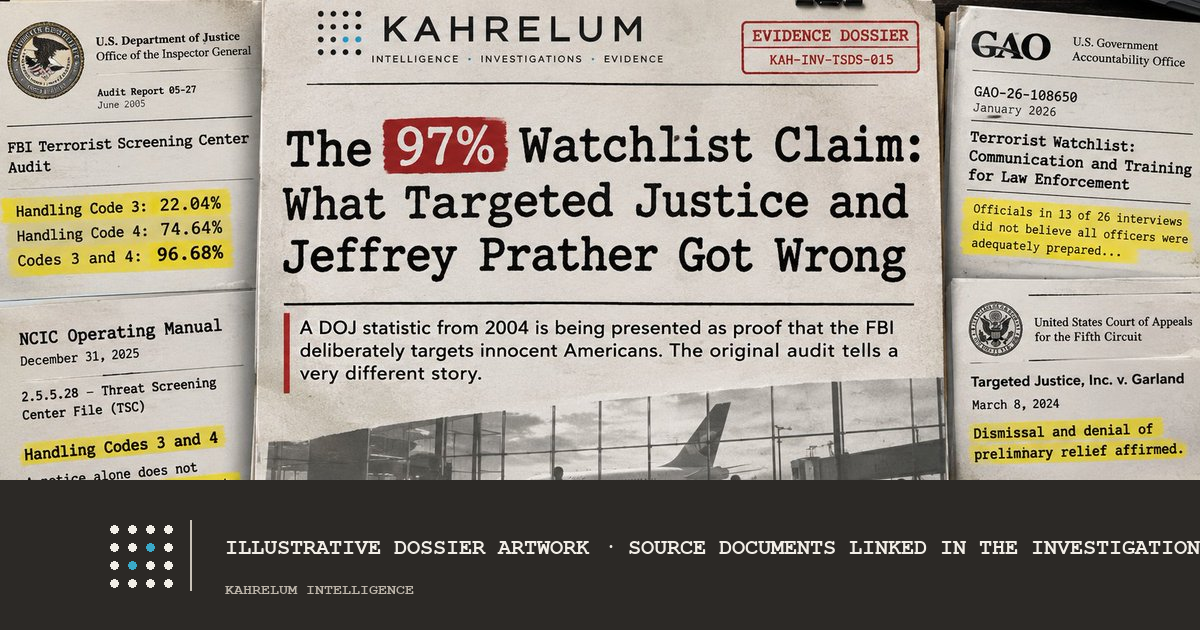
Opening hook: What if one of the most alarming statistics about America's terrorist watchlist is being used to prove something the government audit never actually said?
A recent X Article attributed to Targeted Justice makes an extraordinary allegation: 97% of the individuals in the federal Terrorist Screening Dataset (TSDS) are not terrorists, fail to meet reasonable-suspicion standards, and have been deliberately placed in government databases to facilitate harassment and persecution. Jeffrey Prather subsequently amplified the discussion, citing his claimed intelligence credentials and describing an alleged mechanism involving the Defense Criminal Investigative Service (DCIS) and the FBI's National Crime Information Center (NCIC).
These claims deserve examination because the systems involved are real, their consequences can be serious, and government watchlisting errors are documented. But the central allegation rests on a statistical interpretation that the cited government audit does not support. We examined the original Department of Justice Inspector General reports, FBI watchlisting guidance, the December 2025 NCIC Operating Manual, a January 2026 Government Accountability Office investigation, and relevant federal litigation.
Our finding: The statistical claim is misleading, the proposed mechanism remains unsubstantiated, and the actual oversight failures are serious enough without exaggeration.
1. Where the 97% number actually comes from
In June 2005, the Department of Justice Office of the Inspector General published Audit Report 05-27, reviewing the Terrorist Screening Center. Investigators examined 109,849 historical records from a subset of the then-called Terrorist Screening Database (TSDB), reflecting the database as of October 7, 2004. The breakdown was:
- Handling Code 4: 81,994 records, or 74.64%.
- Handling Code 3: 24,210 records, or 22.04%.
- Handling Code 2: 125 records, or 0.11%.
- Handling Code 1: 193 records, or 0.18%.
- No handling code: 336 records, or 0.31%; other classifications: 2,991 records, or 2.72%.
Codes 3 and 4 together represented 96.68% of the examined records. That is the basis for the widely circulated 97% claim. But these handling codes described the level of law-enforcement response associated with a record. They did not establish whether an individual was innocent, guilty, lawfully watchlisted, or deliberately targeted.
A classification requiring relatively limited police action is not equivalent to a government admission that the person has no terrorism-related intelligence record. The audit does not conclude that 97% of watchlisted individuals were innocent. It does not conclude that 97% failed the applicable inclusion standard. And it does not conclude that the FBI intentionally placed innocent Americans on a secret persecution roster. Those allegations have been added to the statistic, not demonstrated by it.
There is another significant limitation. The examined universe was the set of TSDB 1B records identified for export to the FBI's Violent Gang and Terrorist Organizations File as of October 7, 2004. It represented approximately 53% of the 207,553 records in TSDB 1B at that time. This was not a census of the entire database, much less a description of the modern TSDS. It was a historical snapshot of a particular subset.
2. Handling codes are being confused with watchlist eligibility
The Targeted Justice article says Handling Codes 1 and 2 constitute the actual terrorist watchlist, while Codes 3 and 4 supposedly contain innocent people who fail to meet the minimum suspicion standard. That confuses operational handling instructions with the substantive criteria for inclusion in a screening system.
The FBI's April 2024 watchlisting document explains that the No Fly and Selectee lists are subsets of the broader TSDS and have additional eligibility requirements. They are not simply interchangeable names for Handling Codes 1 and 2. The historical system examined in 2005 used four principal handling codes. The December 31, 2025 NCIC Operating Manual documents five handling-code messages in the Threat Screening Center File. Under that later system, Codes 1 through 3 concern terrorism-related screening; Code 4 concerns other national-security interests; and Code 5 concerns transnational organized crime.
Five current NCIC handling codes do not equal five categories of alleged terrorists, and they cannot be retroactively applied to a 2004 dataset as though the systems never changed. That temporal and definitional mismatch alone undermines the classification argument.
3. Targeted Justice contradicts its own published explanation
There is a revealing inconsistency in Targeted Justice's earlier material. In an August 29, 2026 newsletter titled TSDB Handling Codes, the organization described Handling Code 3 as meeting the TSDB reasonable-suspicion standard and acknowledged that certain associated individuals may qualify for limited screening exceptions. Yet the newer X Article claims that people assigned Codes 3 and 4 do not meet the minimum reasonable-suspicion standard.
Those categorical statements cannot both be accurate. The earlier newsletter also declared that 97% of TSDB names have no known ties to terrorism, attributing that conclusion to the Inspector General. Again, the original audit contains no such conclusion about 97% of people. This is not simply a dispute over wording. It is the repeated transformation of an operational classification into an allegation that government officials knowingly fabricated terrorist suspicion.
4. What the government actually acknowledges
An accurate investigation must recognize information that complicates the government's own account. Footnote 7 of the FBI's April 2024 transparency document acknowledges that some individuals included in the TSDS are connected to known or suspected terrorists but may not independently satisfy the reasonable-suspicion standard. The FBI says those records face restrictions on dissemination and use.
That admission matters. It demonstrates that the broader screening dataset is not composed exclusively of people who independently meet the ordinary terrorism-related suspicion standard. But it does not establish that these records make up 97% of the dataset. It does not establish that they correspond to the historical Code 3 and 4 figures. And it does not establish that they were inserted to facilitate political persecution.
The correct question is whether the exceptions are sufficiently narrow, legally justified, accurately maintained, and subject to effective oversight. That is a legitimate public-accountability investigation.
5. The police-computer claim runs into the NCIC manual
Targeted Justice alleges that innocent individuals are identified as suspected terrorists during routine police encounters because their names or license plates generate law-enforcement alerts. The technical ability to return a potential watchlist match during a traffic stop is real. The January 2026 GAO report confirms that state and local officers can encounter such alerts through NCIC.
But a potential match is not automatically a confirmed identity match, and a screening notice is not an arrest warrant. The December 2025 NCIC Operating Manual instructs officers not to detain or arrest an individual solely on the notice. For Handling Codes 3 and 4, it directs officers to gather information within their existing legal authority and contact the FBI without improperly extending an encounter. Code 1 separately addresses how to proceed when an actual arrest warrant is returned.
A screening alert may initiate verification or intelligence-related procedures. It does not, standing alone, create unrestricted authority to search a vehicle, detain an individual, or arrest someone. Whether officers always follow these rules is another matter. The manual's instructions nevertheless contradict the suggestion that a handling-code notice itself authorizes arbitrary detention.
6. Jeffrey Prather's explanation contains a fundamental error
In his response, Jeffrey Prather describes DCIS and NCIC as two crucial criminal-investigation databases. That is incorrect. The Defense Criminal Investigative Service (DCIS) is a federal investigative organization within the Department of Defense Inspector General structure. It investigates fraud, corruption, security-related crimes, and other offenses affecting the department. It is not a database equivalent to NCIC.
There is a real Defense Department database with a similar acronym: the Defense Central Index of Investigations (DCII). DCII identifies the existence of certain Defense Department investigations and personnel-security determinations. DCII and DCIS are different entities. Prather may have intended to reference DCII; his statement does not establish that.
Even if DCII was his intended reference, the larger allegation remains unsupported. Where is the documented process showing that DCII records are secretly combined with NCIC information to manufacture terrorist suspicion against otherwise innocent citizens? What evidence identifies the agencies responsible for that process? What authenticated records demonstrate its use against particular individuals? The statements provided do not answer those questions. Credentials, even when authentic, cannot replace evidence establishing a specific technical mechanism.
7. The alleged 2014 Cheektowaga traffic stop
The Targeted Justice article recounts a purported 2014 police encounter in Cheektowaga, New York. The individual describes being stopped, placed in the rear of a police vehicle, and photographing a laptop displaying information allegedly linking him to a terrorism database. According to the account, police ultimately released him. The author says the photograph was later digitally enhanced using Grok.
This account may warrant independent investigation, but several important facts remain unverified. The original, unmodified image has not been independently authenticated in the material examined for this review. The underlying police records have not been established. The actual basis for the traffic stop and any search has not been independently confirmed. And the causal connection between the purported computer display and the officer's decision to stop the vehicle has not been demonstrated.
The absence of a terrorism arrest or criminal charge does not, by itself, establish that a screening record was fabricated. Nor does it establish that the encounter was lawful. Both questions require independent evidence. A firsthand allegation deserves examination, but cannot be treated as conclusive proof of a nationwide government program.
8. Targeted Justice has previously litigated related allegations
In Targeted Justice, Inc. v. Garland, plaintiffs alleged that the government used a secret TSDS blacklist to facilitate surveillance, directed-energy attacks, and other forms of targeting. On March 8, 2024, the United States Court of Appeals for the Fifth Circuit affirmed the jurisdictional dismissal of the plaintiffs' constitutional and Administrative Procedure Act claims, describing those particular allegations as frivolous for jurisdictional purposes. The court also upheld procedural dismissals affecting certain Privacy Act claims and the denial of preliminary relief. Other Privacy Act claims had not been dismissed at that stage.
The Supreme Court subsequently declined review. These decisions did not establish that every federal watchlisting practice is lawful. They did not adjudicate the accuracy of the 2005 audit's handling-code distribution. They do show that related secret-blacklist allegations were subjected to judicial scrutiny and were not substantiated in that litigation. The court's disposition should not be inflated into a universal ruling about all watchlisting or civil-liberties claims.
9. Actual government failures are documented
None of this means federal watchlisting is free from abuse or error. The DOJ Inspector General's 2007 follow-up audit reported that 38% of a selected group of 105 records undergoing routine quality-assurance review contained errors or inconsistencies that had escaped detection. It also documented 2,118 records that officials determined should not have been watchlisted in any system and needed removal. Those figures apply to the specific groups examined. They are not estimates of the error rate across the entire watchlist.
More recently, the GAO's January 2026 report found that officials in 13 of 26 interviews did not believe all their officers were adequately prepared to handle terrorist-watchlist encounters. In 12 of 26 interviews, officials said officers were not consistently reporting encounters when reporting was warranted. The GAO warned that knowledge gaps could lead officers to overreact, including through improper arrests, or to mishandle legitimate screening responsibilities.
These are concrete oversight failures supported by independent government investigations. They should be investigated, corrected, and monitored. The possibility of erroneous inclusion, mistaken identity, excessive data retention, and improper police action raises serious constitutional and civil-liberties questions. The public deserves transparent standards, meaningful redress, and independent accountability. None of those goals requires falsely claiming that a 2005 audit proved 97% of people were deliberately targeted.
10. What would establish the alleged government program?
The burden of evidence is not complicated. Produce authenticated records showing people were knowingly entered without the required legal or intelligence basis. Identify the responsible officials and documented procedures. Demonstrate that those entries were deliberately used to punish lawful conduct or facilitate unlawful interference. Connect the records to independently verified incidents. And establish the prevalence of such practices using a representative dataset rather than relabeling operational categories as proof of innocence.
That would justify a serious investigation into systematic wrongdoing. A historical chart of handling codes does not accomplish it.
KAHRELUM assessment
- The 97% allegation is not supported by the cited DOJ audit. The audit reports a 96.68% share of a historical 109,849-record subset carrying Codes 3 or 4; it does not call those people innocent or deliberately targeted.
- The handling-code argument conflates different systems, classification purposes, and historical periods. The 2004 handling-code system should not be merged with the 2025 NCIC system.
- Jeffrey Prather incorrectly identifies DCIS as a database and provides no demonstrated basis for the asserted DCIS–NCIC targeting mechanism. DCIS and DCII must remain distinct.
- Documented watchlisting errors and law-enforcement training deficiencies remain legitimate civil-liberties concerns. The evidence supports oversight, redress, and correction—not a stronger claim than the records can carry.
- The proposed nationwide program of deliberate targeting has not been established by the evidence presented. Targeted Justice has presented a real statistic and attached a conclusion that the statistic does not establish. Prather has offered an additional mechanism without the documentation necessary to verify it.
The strongest investigations do not begin by deciding whether the government is innocent or guilty. They begin by asking what the records can actually prove. In this case, the specific allegations are not proven by the evidence cited.
Sources & primary documentation
- DOJ Inspector General, Audit Report 05-27, Chapter 5 — June 2005 review of the Terrorist Screening Center; historical handling-code statistics and the 109,849-record subset.
- DOJ Inspector General, Audit Report 07-41 — September 2007 follow-up audit documenting data-integrity weaknesses, incorrect records, and removal of 2,118 records.
- FBI, Overview of the U.S. Government's Terrorist Watchlisting Process and Procedures — April 2024; nomination standards, reasonable suspicion, screening exceptions, and watchlist distinctions.
- FBI NCIC Operating Manual — December 31, 2025, Section 2.5.5.28; Threat Screening Center File messages and officer instructions.
- GAO-26-108650, Terrorist Watchlist: FBI Should Improve Outreach Efforts to Nonfederal Users — January 2026; law-enforcement encounters, training, reporting, and oversight weaknesses.
- Fifth Circuit, Targeted Justice, Inc. v. Garland, No. 23-20342 — March 8, 2024; appellate disposition of the pleaded constitutional, APA, and Privacy Act claims.
- DoD Inspector General, Defense Criminal Investigative Service — official agency description of DCIS.
- Defense Counterintelligence and Security Agency, Defense Central Index of Investigations — official description of DCII.
- Targeted Justice, “TSDB Handling Codes” — August 29, 2026; the earlier published explanation examined for internal consistency.
KAHRELUM Intelligence · Evidence before narrative. Sources are provided for independent verification. Findings distinguish documented facts, contested allegations, and unresolved evidentiary questions. This publication does not assert that every watchlisting practice is lawful, that every person on a watchlist is dangerous, or that every account of a screening encounter is false.