Official count cross-check verified
The committee page and downloaded CSV match across all 38 party lists and 1,181 rows: 4,854,102 valid votes + 21,649 invalid votes = 4,875,751 ballots reported. Source update: October 28, 14:32 (timezone not stated on the page). This is a preserved partial count; final results may change. A national percentage of ballots counted is not verified.
Read the verification record →Vote count & coalition scenarios
Check the count status, explore seat estimates and build your own combinations. Counted ballots and model estimates remain separate.
Compare the same votes first
KAHRELUM’s count calculation below uses exactly the complete vote vector in the saved Poliwave snapshot. The Petek’s figures are shown alongside it, with a check on whether its reported vote total matches.
Same-input count calculation
Valid votes used by KAHRELUM and the captured Poliwave allocation
Seats that differ
Total absolute seat difference: KAHRELUM calculation vs Poliwave. This is not a final-result accuracy score.
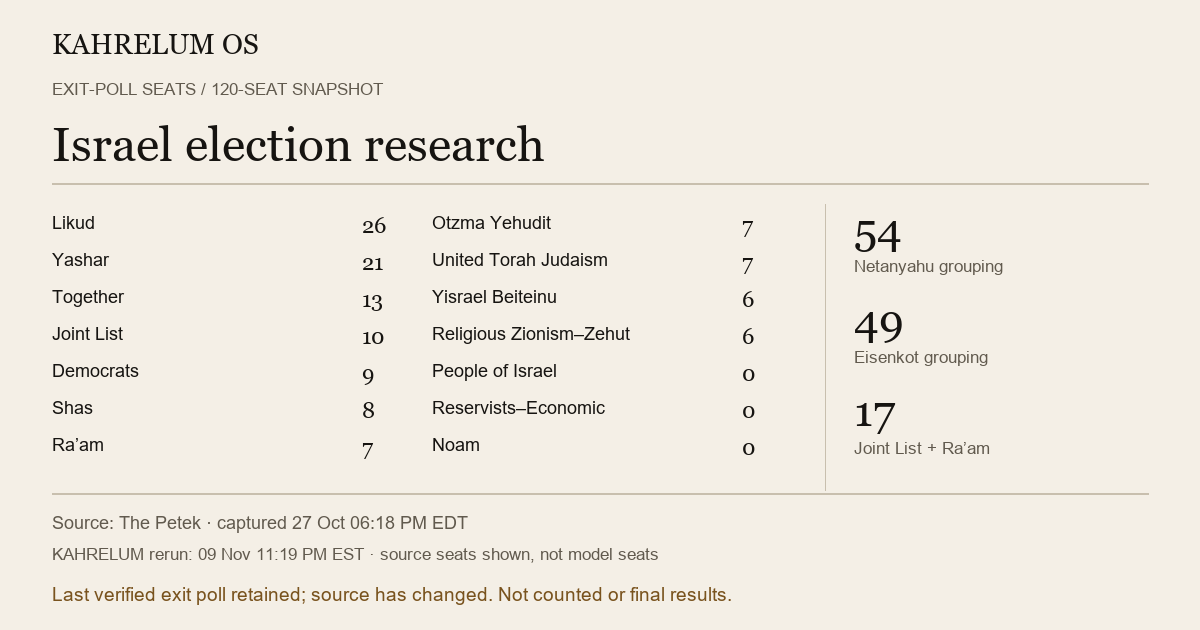
The Petek snapshot
Checking the reported vote total…
| Party | KAHRELUM from Poliwave votes | Poliwave published count seats | The Petek its count snapshot | KAHRELUM exit-informed forecast representative seats · 80% range |
|---|---|---|---|---|
| Total seats | 120 | 120 | 120 | 120 · ranges are separate |
Two different questions: the first columns calculate seats from votes already reported. The final column is the earlier exit-informed forecast, including uncertainty. No column is an official final result. The count calculation assumes five reported surplus-vote agreements; their current official status has not been authenticated here.
Download this comparison and its snapshot identities · See the vote vector and calculation assumptions
Primary counting source: Israel’s Central Elections Committee. The Petek and Israel Votes are independent comparison sources. Their reported figures do not replace a directly verified committee feed.
Poliwave’s count-based seat picture
Poliwave calculates seats from votes reported so far. It explicitly does not call this a final-result forecast or an official seat allocation.
Valid votes in its snapshot
Poliwave’s reported coverage
Polls reported, not a national ballots-counted percentage
Snapshot status
Loading preserved capture…
| Party | Poliwave published seats | KAHRELUM calculation from the same vote snapshot |
|---|---|---|
| Total | 120 | 120 |
The KAHRELUM column independently applies its count-mechanics engine to Poliwave’s complete vote vector, assuming five reported surplus-vote pairs. Agreement currency and direct committee-file custody are unverified. This is a partial-count calculation, not our final-seat forecast. The unchanged exit-informed forecast remains separately labeled.
Open Poliwave’s live results ↗ · Download captured figures and assumptions
Research status: experimental, post-close estimates. Official count availability is shown below. Final accuracy is assessed only against verified final results.
27 Oct · 4:28 AM EDT
Requested input cutoff, reconstructed later from October 23 survey inputs. This prediction was not created or frozen at 4:28 AM. Not C0.
—
Last execution shown above. The original issue time is preserved in the downloads. Every new Israel Votes revision triggers another source check and model rerun; changed numbers require changed verified inputs.
Pending verification
Final accuracy scores remain blank until an official 120-seat allocation is verified.
How much has actually been counted?
Ballots counted
Counted / remaining
Ballots remaining
Awaiting verified ballot totals and a compatible denominator. Exit polls are surveys, not counted ballots. Turnout and polling-station coverage are not counted-vote percentages.
Comparison-site count reports
Valid votes reported
Ballots reported, including invalid
Source: Israel Votes’ relay of the committee count. The reported totals pass our arithmetic checks, but we have not independently fetched the same committee file. A national percentage counted is shown only when its ballot denominator has been verified.
Update timing: we check both comparison sites every minute. New count snapshots trigger our existing collection and model rerun; publication follows validation. Source availability and the computer’s connection can delay updates.
The Petek reports 99.37% counted
The Petek has switched from exit polls to a seat picture based on the ballots reported so far. That is a very early count, not a representative sample of all remaining votes.
Checking source capture…
Why our official-count fields may still say Unknown: we have not independently verified the national ballot denominator. We show The Petek’s percentage as its report; it is not our own verified completion percentage.
Open The Petek’s count report ↗Projected seats from the count so far
If the ballots reported so far were the whole election, this would be The Petek’s 120-seat allocation. The remaining ballots can change it substantially. These are not KAHRELUM’s final-seat projections.
Seats from this early count
Includes Reservists–Economic; differs from our fixed four-party Eisenkot grouping
Of 120 seats
| Party | Seats from the early count | Share of reported valid votes |
|---|
Threshold watch · 3.25% of valid votes
These percentages describe the ballots reported so far. Crossing the line in an early count does not guarantee a party will stay above it.
Where the count stands
- Voting closed: exit-poll estimates were published.
- Now: early counting. The Petek reports 99.37% counted. The first reported ballots can differ sharply from the rest of the country.
- More ballots arrive: the seat picture and threshold positions can change. Special-envelope ballots may arrive later than ordinary polling-station ballots.
- Verified final allocation: our forecast accuracy scores are calculated only once official final seats are verified.
This is a sequence of counting stages, not a guarantee that a particular percentage will be counted by a particular hour.
Same starting numbers. Three ways to allow for uncertainty.
The input snapshot chooses the starting seat estimates: earlier survey inputs or the displayed exit-poll inputs. The uncertainty model chooses how possible results can vary around those estimates.
Explain all three choices
Fixed Gaussian: a fixed error setting
Think of a bell curve: small misses are more common than large ones. This version starts with the same fixed error setting for every party, rather than estimating that setting from past elections.
Shrinkage Gaussian: learn cautiously from the past
This also uses a bell curve, but sets the size of possible errors using past polling misses. It blends that evidence with the fixed setting so a small amount of history cannot dominate. “Shrinkage” describes this blending of the error setting; it does not mean cutting a party’s predicted seats.
Correlated Student: allow bigger surprises
This uses the same history-based error setting, but gives unusually large misses more room than the bell-curve versions. A shared surprise factor can make several parties’ errors larger in the same simulation. It does not learn which particular parties or blocs will move together.
What changes on this page?
The seat estimates, ranges and conditional coalition percentages for the selected KAHRELUM model can change. Every simulated parliament still has 120 seats, so gains and losses must balance. Switching the model does not fetch new votes or change the independent Israel Votes forecast.
No choice is guaranteed to be best. These are experimental ways to describe uncertainty. The default is Correlated Student; its position in the menu is not evidence that it is more accurate. The separate head-to-head comparison retains its documented primary method.
Netanyahu bloc
Gadi Eisenkot bloc
Means and 90% ranges summarize model draws. Netanyahu bloc: Likud, Otzma Yehudit, Shas, UTJ and Religious Zionism–Zehut. Eisenkot bloc: Yashar, Together, Democrats and Yisrael Beiteinu. These fixed groupings do not establish future coalition agreements. No prime minister call is made.
Seat estimates and latest observation
| List / party | KAHRELUM expected seats | 90% model range | Latest source seats | Δ vs source | Official final |
|---|---|---|---|---|---|
| Total | — | Joint draws: 120 each | — | — | Pending |
Expected seats can be fractional, including below the model's minimum positive allocation. Means are distribution summaries, not legal single-election seat allocations. The 14-list model excludes other ballot lists.
Who could join—and would the seats add up?
Choose parties and roles. The model calculates the percentage of its seat draws in which that arrangement has enough support. Having enough seats does not mean the parties have agreed to work together.
These percentages forecast seat availability under your assumptions, not the chance a government will actually form. Scenarios overlap and their percentages do not add to 100%.
Enough seats is only half the story
The numbers question: do your chosen parties have enough seats? The model helps you explore this.
The agreement question: will those parties actually agree to support the same government? They may disagree over the leader, policies or who else joins. We show reported positions below, but do not predict whether a deal will happen.
Three ways a party can help
- Join the government: become part of the governing team.
- Support it from outside: vote to let it take office without joining the team.
- Abstain: choose neither yes nor no in the vote we are modeling. This can leave fewer votes against the government.
How to read the percentages
If a card says 80%, your arrangement has enough seats in 80 out of 100 model simulations for that card’s test. It does not mean there is an 80% chance the parties will make a deal.
Example: with 60 votes for, 59 against and one abstention, there are more votes for than against—even though the governing parties do not hold 61 seats. This is vote arithmetic under those assumptions, not a promise that the arrangement will happen.
Customize cabinet members, outside supporters and abstaining parties
Choose a role for each party: Cabinet member joins your proposed government. Outside supporter votes for it without joining. Abstains takes neither side. Opponent / not selected votes against it under this scenario’s assumptions.
Start from a preset, change any party below, and watch the three percentage cards update. Use “Clear selection” to start again with every party opposing. Your custom selections stay in this tab; the share page does not save or include them.
Outside support does not mean joining the cabinet.
Conditional on your roles, full attendance and every unselected party opposing. This includes abstentions.
Will these parties actually make a deal? We do not estimate that. The calculator tests the seats; it cannot tell whether negotiations will succeed. These calculations reuse the selected KAHRELUM seat model and its uncertainty limitations; they do not modify the frozen forecast.
Possible combinations — and what might stop them
| Scenario | Government parties reach 61 | With outside votes, reach 61 | More votes for than against | Have they agreed to work together? |
|---|
What the parties have said
Check the dates on the reports: parties can change their positions. Talking to another party is not the same as agreeing to govern together. This calculator assigns a role to each whole party; it does not model individual members changing sides.
120 seats. Half is 60. A majority starts at 61.
Think of parliament as a room with 120 chairs, each with one vote. At 60 seats, your group controls exactly half the room. At 61, it has more votes than all the remaining 59 members combined.
One party rarely gets 61 on its own. Parties usually agree to work together in a coalition. For example: 25 + 14 + 9 + 7 + 6 = 61. Winning the most seats is different from assembling a majority.
The nuance: 61 is an outright majority of all seats. Not every parliamentary vote requires 61 votes. A government can sometimes take office with fewer coalition members if outside members support it or abstain, leaving more votes for than against. The largest party's leader does not automatically become prime minister. Knesset voting rules · Minority-government explanation
Sources, methods and research limits
Explore the research
KAHRELUM vs Israel Votes: who is closer?
We compare two saved predictions with the seats implied by the latest reported count. Fewer error points means a closer prediction. This is a running comparison, not a final result.
| Group | KAHRELUM predicted | Israel Votes predicted | Count so far / try a scenario |
|---|---|---|---|
| Netanyahu grouping | 55 | 51 | |
| Change / Eisenkot grouping | 48 | 50 | |
| Joint List + Ra’am | 17 | 19 |
Loading comparison…
How this comparison works
The default gives each main competing bloc twice the weight of Joint List + Ra’am. In the default score, an exact Netanyahu or Eisenkot grouping earns a 3-point deduction; an exact combined Arab-party total earns 2. Lower net error is better; totals can be negative. Different publication times and inputs mean this is not a controlled comparison.
This weighting was chosen after partial results were available. The original scoring rules and party-level comparisons remain preserved. Final grading will use independently verified official final seats. Scenario changes are your examples, not forecasts.
Original weighted scoring record · Exact-hit bonus ruleWho made the predictions?
KAHRELUM is an owner-led project: one person using AI-assisted research and numerical models. The saved KAHRELUM projection compared here was created after polls closed using exit-poll information. The Israel Votes projection was published at a different time using its own model. Israel Votes describes itself as Rabbi Daniel Bogard’s personal project, independent of his congregation, with AI-assisted development. Its public build log records development and a live deployment on October 4, 2026; GitHub records repository creation on October 5. This documents roughly three and a half weeks of this website by October 29, not the length of its creator’s election-teaching experience. Its exact staffing is not independently established. Both projects are owner-led and use AI assistance; we do not describe this as one person beating a large organization. Israel Votes: About · Build history · Repository creation record.
Visit Israel Votes