Official count cross-check verified
The committee page and downloaded CSV match across all 38 party lists and 1,181 rows: 4,854,102 valid votes + 21,649 invalid votes = 4,875,751 ballots reported. Source update: October 28, 14:32 (timezone not stated on the page). This is a preserved partial count; final results may change. A national percentage of ballots counted is not verified.
Read the verification record →THE ELECTION MODEL SHOWDOWN
KAHRELUM and three independent sources
Compare the preserved seat estimates from KAHRELUM and Israel Votes. Final accuracy scores will be available once official results are verified.
Poliwave’s count-based seat picture
Poliwave calculates seats from votes reported so far. It explicitly does not call this a final-result forecast or an official seat allocation.
Valid votes in its snapshot
Poliwave’s reported coverage
Polls reported, not a national ballots-counted percentage
Snapshot status
Loading preserved capture…
| Party | Poliwave published seats | KAHRELUM calculation from the same vote snapshot |
|---|---|---|
| Total | 120 | 120 |
The KAHRELUM column independently applies its count-mechanics engine to Poliwave’s complete vote vector, assuming five reported surplus-vote pairs. Agreement currency and direct committee-file custody are unverified. This is a partial-count calculation, not our final-seat forecast. The unchanged exit-informed forecast remains separately labeled.
Open Poliwave’s live results ↗ · Download captured figures and assumptions
Awaiting final results · No accuracy winner declared
Both captured models had access to post-close information. Their issue times and inputs differ.
Head to head: KAHRELUM vs Israel Votes and The Petek
See the early count, party seats and threshold watch →
Track our forecast against both sites. The table uses each model’s single saved 120-seat example and The Petek’s seat allocation from its partial count.
Different stages of information: KAHRELUM and Israel Votes are exit-informed models. The Petek column is currently count-based. Differences are not accuracy scores, and this is not an equal-information contest.
KAHRELUM
Our forecast · Correlated Student
Israel Votes
Independent exit-informed forecast
The Petek
Early-count seat picture · reports 99.37% counted
| Party | KAHRELUM 120-seat example | Israel Votes 120-seat example | The Petek count-based seats |
|---|---|---|---|
| Total | 120 | 120 | 120 |
Loading comparison…
Download first preserved Petek comparison · Download current three-way snapshot
The Petek comparison was registered after early counting began. Its source percentage has not been independently verified against a national denominator. Its seats do not become KAHRELUM model inputs. Final scoring requires verified official final seats; the original C0 and existing Israel Votes score plan remain unchanged.
KAHRELUM
K-PREDICT
Experimental seat-space model
Correlated Student method
INDEPENDENT COMPARATOR
Israel Votes 2026
Published external forecast
israelielection.org ↗
The locked bloc comparison
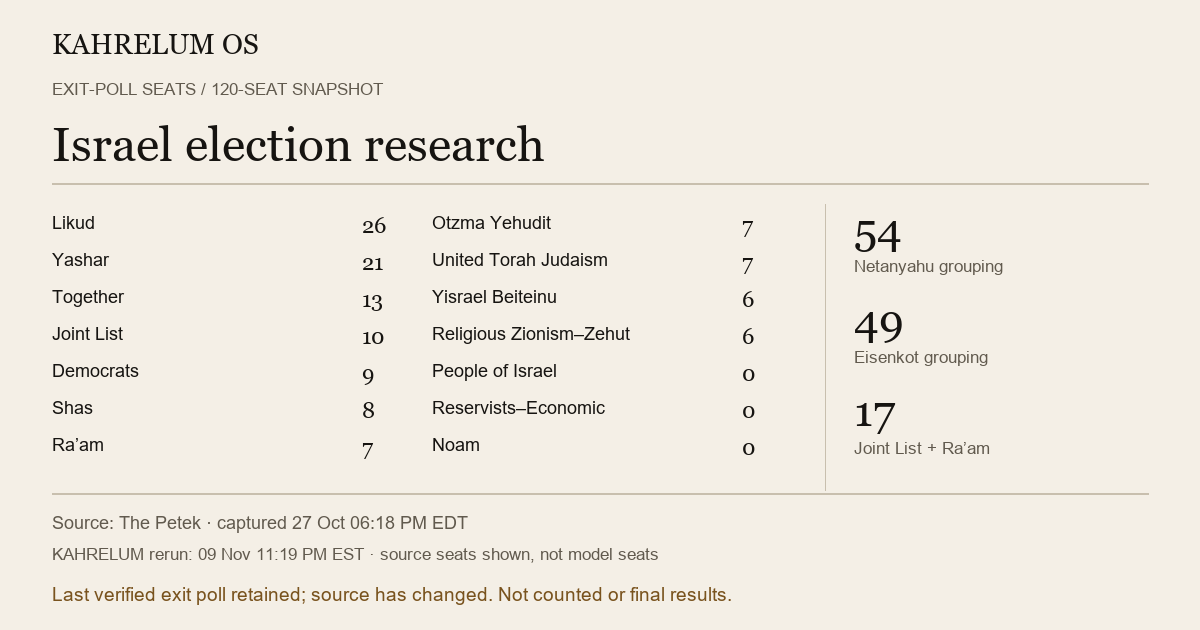
Captured at 2026-10-27T20:55:59.484461Z. Sums of party-level median seat estimates. Differences measure disagreement, not accuracy.
| Grouping | KAHRELUM | Israel Votes | Difference |
|---|---|---|---|
| Netanyahu grouping | 54 | 49 | +5 |
| Eisenkot grouping | 49 | 52 | -3 |
| Joint List + Ra’am | 17 | 17 | +0 |
Party medians need not total 120. These groupings describe seat arithmetic, not agreed governing coalitions. Other modeled lists are excluded from these three subtotals. The live dashboard shows the complete party comparison and current revisions.
How will accuracy be judged?
The preserved comparison protocol specifies seat-error measures and other checks against verified official final results. Final scores remain blank until those results are admitted. No superiority claim has been established. KAHRELUM’s probabilities and ranges are experimental and uncalibrated.
Read the scoring protocolSocial preview image
This fixed graphic identifies the comparison and its pending status. It is not a real-time result card. Social platforms may cache previews.
Independent comparison; no affiliation or endorsement by Israel Votes is implied.
Explore the research
KAHRELUM vs Israel Votes: who is closer?
We compare two saved predictions with the seats implied by the latest reported count. Fewer error points means a closer prediction. This is a running comparison, not a final result.
| Group | KAHRELUM predicted | Israel Votes predicted | Count so far / try a scenario |
|---|---|---|---|
| Netanyahu grouping | 55 | 51 | |
| Change / Eisenkot grouping | 48 | 50 | |
| Joint List + Ra’am | 17 | 19 |
Loading comparison…
How this comparison works
The default gives each main competing bloc twice the weight of Joint List + Ra’am. In the default score, an exact Netanyahu or Eisenkot grouping earns a 3-point deduction; an exact combined Arab-party total earns 2. Lower net error is better; totals can be negative. Different publication times and inputs mean this is not a controlled comparison.
This weighting was chosen after partial results were available. The original scoring rules and party-level comparisons remain preserved. Final grading will use independently verified official final seats. Scenario changes are your examples, not forecasts.
Original weighted scoring record · Exact-hit bonus ruleWho made the predictions?
KAHRELUM is an owner-led project: one person using AI-assisted research and numerical models. The saved KAHRELUM projection compared here was created after polls closed using exit-poll information. The Israel Votes projection was published at a different time using its own model. Israel Votes describes itself as Rabbi Daniel Bogard’s personal project, independent of his congregation, with AI-assisted development. Its public build log records development and a live deployment on October 4, 2026; GitHub records repository creation on October 5. This documents roughly three and a half weeks of this website by October 29, not the length of its creator’s election-teaching experience. Its exact staffing is not independently established. Both projects are owner-led and use AI assistance; we do not describe this as one person beating a large organization. Israel Votes: About · Build history · Repository creation record.
Visit Israel Votes