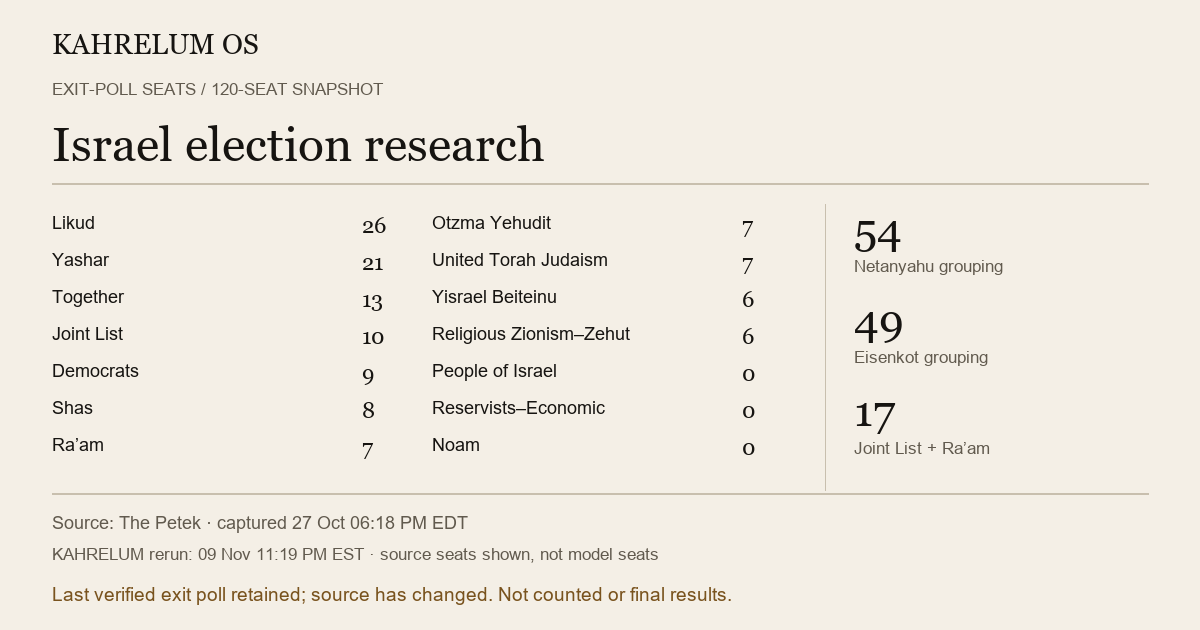
The committee page and downloaded CSV match across all 38 party lists and 1,181 rows: 4,854,102 valid votes + 21,649 invalid votes = 4,875,751 ballots reported. Source update: October 28, 14:32 (timezone not stated on the page). This is a preserved partial count; final results may change. A national percentage of ballots counted is not verified.
Research status: experimental, post-close estimates. Official count availability is shown below. Final accuracy is assessed only against verified final results.
Additional independent source · Poliwave
Poliwave’s count-based seat picture
Poliwave calculates seats from votes reported so far. It explicitly does not call this a final-result forecast or an official seat allocation.
Valid votes in its snapshot
—
Poliwave’s reported coverage
—
Polls reported, not a national ballots-counted percentage
Snapshot status
Loading preserved capture…
Party
Poliwave published seats
KAHRELUM calculation from the same vote snapshot
Total
120
120
The KAHRELUM column independently applies its count-mechanics engine to Poliwave’s complete vote vector, assuming five reported surplus-vote pairs. Agreement currency and direct committee-file custody are unverified. This is a partial-count calculation, not our final-seat forecast. The unchanged exit-informed forecast remains separately labeled.
Each dot is one seat. Both pictures show a complete 120-seat model example. Choose a party below to compare its seats and uncertainty range.
KAHRELUM: Correlated Student · Israel Votes: published model
Loading the saved comparison…
KAHRELUM
120 seats
Israel Votes
120 seats
61 seats is an outright majority. The maps show one saved allocation from each model, not counted votes or a prediction that these parties will form a government. The separate party ranges below describe many possible allocations; their endpoints do not add to 120.
Colors identify parties only. Groupings are the dashboard’s fixed seat groupings, not confirmed coalition agreements. The 14 modeled lists do not cover every ballot list.
Choose a party to see its numbers
Use a party button above. Compare the saved seat examples and each model’s 80% range.
Same colors, scale and party order in both maps. The two models can have different inputs and issue times. No accuracy winner has been declared.
New here? A four-step guide to using this research
First visit? Start here
Use this page in four simple steps
You do not need to know the models or the parties to explore. Your selections only change your own view.
Check what the numbers represent
Open Vote count to see whether verified counted ballots are available. “Unknown” means we do not have a verified figure. Exit-poll estimates are surveys, not counted votes.
Choose the numbers and model
Use the snapshot and model controls above the model guide. The snapshot selects earlier survey inputs or current exit-poll inputs. Leave Correlated Student selected to start; the guide explains the other choices.
Build your own coalition
Go to Coalitions. Pick a ready-made scenario, or open the party controls and assign each party a role. The percentages update as you change your selections.
Read the result, then compare
“Cabinet reaches 61” counts cabinet parties only. “With outside support” adds supporters. “More yes than no” also accounts for abstentions. Then visit Model comparison to see how the published forecasts differ.
Keep in mind: a scenario percentage is how often the selected parties have enough seats in the model simulations. It is not the probability they will agree to govern. Model choices do not change official results.
Connecting to the research feed…
Frozen-input view · morning cutoff
27 Oct · 4:28 AM EDT
Requested input cutoff, reconstructed later from October 23 survey inputs. This prediction was not created or frozen at 4:28 AM. Not C0.
Current view · first run 4:28 PM EDT
—
Last execution shown above. The original issue time is preserved in the downloads. Every new Israel Votes revision triggers another source check and model rerun; changed numbers require changed verified inputs.
Official final result
Pending verification
Final accuracy scores remain blank until an official 120-seat allocation is verified.
Official count progress
How much has actually been counted?
Ballots counted
Unknown
Counted / remaining
Unknown
Ballots remaining
Unknown
Awaiting verified ballot totals and a compatible denominator. Exit polls are surveys, not counted ballots. Turnout and polling-station coverage are not counted-vote percentages.
Understanding the model choices
Same starting numbers. Three ways to allow for uncertainty.
The input snapshot chooses the starting seat estimates: earlier survey inputs or the displayed exit-poll inputs. The uncertainty model chooses how possible results can vary around those estimates.
Explain all three choices
Fixed Gaussian: a fixed error setting
Think of a bell curve: small misses are more common than large ones. This version starts with the same fixed error setting for every party, rather than estimating that setting from past elections.
Shrinkage Gaussian: learn cautiously from the past
This also uses a bell curve, but sets the size of possible errors using past polling misses. It blends that evidence with the fixed setting so a small amount of history cannot dominate. “Shrinkage” describes this blending of the error setting; it does not mean cutting a party’s predicted seats.
Correlated Student: allow bigger surprises
This uses the same history-based error setting, but gives unusually large misses more room than the bell-curve versions. A shared surprise factor can make several parties’ errors larger in the same simulation. It does not learn which particular parties or blocs will move together.
What changes on this page?
The seat estimates, ranges and conditional coalition percentages for the selected KAHRELUM model can change. Every simulated parliament still has 120 seats, so gains and losses must balance. Switching the model does not fetch new votes or change the independent Israel Votes forecast.
No choice is guaranteed to be best. These are experimental ways to describe uncertainty. The default is Correlated Student; its position in the menu is not evidence that it is more accurate. The separate head-to-head comparison retains its documented primary method.
Strict largest-list model call
—
Netanyahu bloc
—
Gadi Eisenkot bloc
—
Five-party grouping
Netanyahu bloc
—
Zionist opposition grouping
Gadi Eisenkot bloc
—
Means and 90% ranges summarize model draws. Netanyahu bloc: Likud, Otzma Yehudit, Shas, UTJ and Religious Zionism–Zehut. Eisenkot bloc: Yashar, Together, Democrats and Yisrael Beiteinu. These fixed groupings do not establish future coalition agreements. No prime minister call is made.
Expected seats can be fractional, including below the model's minimum positive allocation. Means are distribution summaries, not legal single-election seat allocations. The 14-list model excludes other ballot lists.
The rendered source may include different broadcasters over time. A changed source panel is disclosed and creates a new nowcast; it is not silently treated as voter movement.
Conditional probabilities
Largest list, including ties
Uncalibrated model probabilities. The exit-poll nowcast inherits historical polling-error assumptions; no exit-poll-specific error model has been validated.
Coalition explorer · conditional forecasts
Who could join—and would the seats add up?
Choose parties and roles. The model calculates the percentage of its seat draws in which that arrangement has enough support. Having enough seats does not mean the parties have agreed to work together.
These percentages forecast seat availability under your assumptions, not the chance a government will actually form. Scenarios overlap and their percentages do not add to 100%.
Enough seats is only half the story
The numbers question: do your chosen parties have enough seats? The model helps you explore this.
The agreement question: will those parties actually agree to support the same government? They may disagree over the leader, policies or who else joins. We show reported positions below, but do not predict whether a deal will happen.
Three ways a party can help
Join the government: become part of the governing team.
Support it from outside: vote to let it take office without joining the team.
Abstain: choose neither yes nor no in the vote we are modeling. This can leave fewer votes against the government.
How to read the percentages
If a card says 80%, your arrangement has enough seats in 80 out of 100 model simulations for that card’s test. It does not mean there is an 80% chance the parties will make a deal.
Example: with 60 votes for, 59 against and one abstention, there are more votes for than against—even though the governing parties do not hold 61 seats. This is vote arithmetic under those assumptions, not a promise that the arrangement will happen.
Loading coalition model output…
Customize cabinet members, outside supporters and abstaining parties
Choose a role for each party: Cabinet member joins your proposed government. Outside supporter votes for it without joining. Abstains takes neither side. Opponent / not selected votes against it under this scenario’s assumptions.
Start from a preset, change any party below, and watch the three percentage cards update. Use “Clear selection” to start again with every party opposing. Your custom selections stay in this tab; the share page does not save or include them.
Cabinet parties reach 61
—
Cabinet + outside support reach 61
—
Outside support does not mean joining the cabinet.
More yes votes than no votes
—
Conditional on your roles, full attendance and every unselected party opposing. This includes abstentions.
Will these parties actually make a deal? We do not estimate that. The calculator tests the seats; it cannot tell whether negotiations will succeed. These calculations reuse the selected KAHRELUM seat model and its uncertainty limitations; they do not modify the frozen forecast.
Possible combinations — and what might stop them
Scenario
Government parties reach 61
With outside votes, reach 61
More votes for than against
Have they agreed to work together?
What the parties have said
Check the dates on the reports: parties can change their positions. Talking to another party is not the same as agreeing to govern together. This calculator assigns a role to each whole party; it does not model individual members changing sides.
Compare the two exit-informed models against the same final result. We keep the first captured pair fixed and retain later updates separately.
Comparator: israelielection.org, the existing case comparator. The requested israelelections.org address was inaccessible.
KAHRELUM largest-list call
—
Israel Votes largest-list call
—
Locked-pair contest
Waiting for official final seats
Bloc totals · model differences
Sums of the party estimates in the selected comparison. Difference = KAHRELUM minus Israel Votes. These are not separately simulated bloc medians.
Bloc
KAHRELUM
Israel Votes
Difference
List / party
KAHRELUM median seats
Israel Votes median seats
Difference K minus IV
KAHRELUM 80% range
Israel Votes 80% range
Official final
Median-to-median comparison; both ranges cover 80% of model draws. Separate marginal medians need not add to 120 and are not renormalized. Each model's coherent 120-seat allocation is retained separately.
How we determine which performed better
Primary metric: mean absolute seat error across the same 14 lists. Each model's marginal median is compared with verified official final seats; lower is better. Secondary measures retain total absolute error, root mean squared error, coherent-allocation error and largest-list Brier score including ties. Equal primary scores are a tie. Coverage of 80% ranges is descriptive; one election cannot establish calibration.
The first captured post-close pair is locked for the primary contest. Later forecasts remain separate. The saved campaign forecast is context, not a fair pre-election-versus-post-close contest. The models have different input panels and issue times; this is an observational comparison, not a controlled equal-information trial. Neither rival forecasts nor exit polls are official gold.
Think of parliament as a room with 120 chairs, each with one vote. At 60 seats, your group controls exactly half the room. At 61, it has more votes than all the remaining 59 members combined.
One party rarely gets 61 on its own. Parties usually agree to work together in a coalition. For example: 25 + 14 + 9 + 7 + 6 = 61. Winning the most seats is different from assembling a majority.
The nuance: 61 is an outright majority of all seats. Not every parliamentary vote requires 61 votes. A government can sometimes take office with fewer coalition members if outside members support it or abstain, leaving more votes for than against. The largest party's leader does not automatically become prime minister. Knesset voting rules · Minority-government explanation
Sources, methods and research limits
Prediction timing and integrity
The requested morning input cutoff is October 27, 4:28 AM U.S. Eastern daylight time (08:28 UTC). It is a retrospective comparison cutoff, not an authenticated morning freeze. The first current run was generated at 4:28 PM EDT (20:28 UTC). Both forecasts were generated after scheduled poll close and after exit-poll information was inspected. The frozen-input version uses only the preserved October 23 numerical survey inputs, but it cannot honestly be called a pre-election prediction. C0 and the October 26 scoring protocol are preserved. A revised nowcast is appended as a new prediction; earlier predictions remain downloadable.
K-PREDICT v0.6 seat-space model applied through a new 2026 adapter. Each method uses 12,000 joint draws and historical D−2 residuals through 2022. The inherited support hurdle and Hamilton redistribution are heuristics, not a genuine vote-share model or Bader–Ofer simulation. All three uncertainty specifications are shown; no retrospective winner selection. Historical validation remains partial, probability calibration and prospective superiority unestablished. This is not execution of the immutable KAHRELUM OS v2.3.4 runtime.
This page requests the published feed every minute. Every ten minutes, the scheduled run checks sources and actually recomputes all three models for both input snapshots. Unchanged inputs retain the original forecast issue time; each execution is recorded separately. New official data is reviewed for election identity, stage, timestamp, units and coverage before it can change the model. Partial counts are not treated as final results. The background source collector checks approximately every ten minutes from the owner's computer; the computer must remain awake, online and authenticated. A missed heartbeat shows a stale-data warning. No synthetic votes, percent-counted estimate or official result is substituted when a source is unavailable. Automatic promotion from exit-poll pages to official counts requires a verified compatible source adapter; until then official counts remain unavailable. Differences against provisional sources are displayed as differences, not final errors. The frozen forecast will be evaluated only against verified official final seats; later nowcasts are separate runs.
We compare two saved predictions with the seats implied by the latest reported count. Fewer error points means a closer prediction. This is a running comparison, not a final result.
Group
KAHRELUM predicted
Israel Votes predicted
Count so far / try a scenario
Netanyahu grouping
55
51
Change / Eisenkot grouping
48
50
Joint List + Ra’am
17
19
KAHRELUM vs ISRAEL VOTES
Loading comparison…
How this comparison works
The default gives each main competing bloc twice the weight of Joint List + Ra’am. In the default score, an exact Netanyahu or Eisenkot grouping earns a 3-point deduction; an exact combined Arab-party total earns 2. Lower net error is better; totals can be negative. Different publication times and inputs mean this is not a controlled comparison.
This weighting was chosen after partial results were available. The original scoring rules and party-level comparisons remain preserved. Final grading will use independently verified official final seats. Scenario changes are your examples, not forecasts.
KAHRELUM is an owner-led project: one person using AI-assisted research and numerical models. The saved KAHRELUM projection compared here was created after polls closed using exit-poll information. The Israel Votes projection was published at a different time using its own model. Israel Votes describes itself as Rabbi Daniel Bogard’s personal project, independent of his congregation, with AI-assisted development. Its public build log records development and a live deployment on October 4, 2026; GitHub records repository creation on October 5. This documents roughly three and a half weeks of this website by October 29, not the length of its creator’s election-teaching experience. Its exact staffing is not independently established. Both projects are owner-led and use AI assistance; we do not describe this as one person beating a large organization. Israel Votes: About · Build history · Repository creation record.